
We had the pleasure to welcome Thierry Valet on February 11 and 12. If it was that he was not completely unaware of German Carnival traditions, we do not know. In any case, he was lucky not to wear a tie when he took off for a meeting with Jairo Sinova and Matthias Kläui. Mr Valet is known for the Valet-Fert Theory and Model on giant magnetoresistance in CPP geometry and the application of his research in spin engineering.
Allgemein
12.02.2015 – Thierry Valet meets with our group and German Carnival traditions during his visit at INSPIRE and SPICE Center
Facilities on Campus
Internet
Free wireless internet access is provided all over the campus via Eduroam or Winulum. With a guest account you can also use wired internet via network outlets in the offices. For more information please see: https://www.en-zdv.uni-mainz.de/internet-and-net-access/
Phone calls
International country code Germany: +49
Mainz area code: 06131 (without "0" when calling from outside Germany)
The Spice guest office is equipped with telephones. For calls inside the University you only need the 5-digits extension. Phone numbers of the University staff can be found on the University's information platform Univis. For phone calls outside the campus please dial "0" to obtain an exterior line.
University Cash Card ("Studicard")
You will need the Studicard to pay for lunch in the university Mensa. The card is available at the Studierendenwerk office next to the stationary shop on the upper floor of the Mensa.
It can also be used for payments in the Cafeterias on campus. You can charge the card at any of the payment stations located throughout the campus.
Cash payment is possible only at the Mens@ria Cafeteria on the upper floor on the Mensa.
Banks and Cash Points
Sparkasse Mainz and Mainzer Volksbank have ATMs on campus.
You can find a list of various banks in Mainz online: www.gelbeseiten.de/banken/mainz
Library
| Central Library www.ub-eng.uni-mainz.de/central-library |
||
| Jakob-Welder-Weg 6 55128 Mainz +49 6131 39-22633 info@ub.uni-mainz.de |
Opening Hours: Mon - Fri: 8 a.m. - 12 midnight Sat - Sun: 10 a.m. - 12 midnight The library will be closed on all public holidays |
|
| Departmental Library for Physics, Mathematics and Chemistry (PMC) www.ub-eng.uni-mainz.de/departmental-library-for-physics-mathematics-and-chemistry-pmc |
||
| Duesbergweg 10-14 55128 Mainz +49 6131 39-20454 bbpmc@ub.uni-mainz.de |
Opening hours: Mon - Fri: 8 a.m. - 10 p.m. Sat - Sun: 10 a.m. - 10 p.m. |
|
Food
Close to the physics building:
Main Canteen: Mensa and Mens@ria
Staudingerweg 15
Mensaria: Mon - Thu: 8 a.m. - 7 p.m.
Fri: 8 a.m. - 6 p.m.
Mensa: Mon: - Fri: 11:30 a.m. - 2:20 p.m.
Sat: 11:30 a.m. - 1:15 p.m.
Sat: 11:30 a.m. - 1:15 p.m.
Please note: In order to pay in the MENSA, you need the university cash card "Studicard" which is available at the Studierendenwerk office next to the stationary shop on the upper floor of the Mensa. www.studierendenwerk-mainz.de/sistudent/index.php?id=sis
Imbiss Diwan
Oriental food and Pizza
Johann-Joachim-Becher-Weg 23a
Mon - Fri: 11:30 a.m. - 8 p.m.
Sat: 11:30 a.m. - 3 p.m.
Oriental food and Pizza
Johann-Joachim-Becher-Weg 23a
Mon - Fri: 11:30 a.m. - 8 p.m.
Sat: 11:30 a.m. - 3 p.m.
DeDe's Campus-Döner
Staudingerweg 21
Mon - Fri: 7.30 a.m. - 9 p.m.
Sat: 9 a.m. - 3 p.m.
Sat: 9 a.m. - 3 p.m.
MPIP-Cafeteria
Small and cosy canteen of the Max Planck Institute for Polymere Research
Ackermannweg 10
Mon - Thu: 8 a.m. - 4 p.m.
Fri: 8 a.m. - 3 p.m.
Ackermannweg 10
Mon - Thu: 8 a.m. - 4 p.m.
Fri: 8 a.m. - 3 p.m.
Further options on Campus
Cafeteria at Philosophicum
Jakob-Welder-Weg 18
Mon - Thu: 9 a.m. - 4:30 p.m.
Fri: 9 a.m. - 1 p.m.
Fri: 9 a.m. - 1 p.m.
Canteen at Georg-Forster-Gebäude
Jakob-Welder-Weg 12
Mon-Thu: 10 a.m. - 8 p.m.
Fri: 10 a.m.-7 p.m.
Cafeteria at ReWi
Jakob-Welder-Weg 9
Mon - Thu: 8:30 a.m. - 7 p.m.
Fri: 8:30 a.m.-6 p.m.
Jakob-Welder-Weg 9
Mon - Thu: 8:30 a.m. - 7 p.m.
Fri: 8:30 a.m.-6 p.m.
K3-canteen (FH-Campus)
Lucy-Hillebrand-Straße 2
Mon - Fri: 11.30 a.m. - 2 p.m.
Baron
Johann-Joachim-Becher-Weg 3
Mon - Sat: 9 a.m. - open end
Kulturcafé
Johann-Joachim-Becher-Weg 5
Mon - Fri: 9 a.m. - 6 p.m.
food only from: 11 a.m. - 2 p.m.
www.kulturcafe-mainz.de
unikat.
Werners Bakery
Kolonaden, Entrance Forum
Mon - Fri: 7 a.m. - 7 p.m.
Sat: 7 a.m. - 2 p.m.
khg cafeteria, bistro & World Shop
Catholic Community of St. Albertus
Saarstraße 20
Mon - Fri: 11:30 a.m. - 2 p.m.
www.khg-mainz.de
Visa
Depending on where you come from, you might need a visa to enter Germany. Kindly be informed that guests and workshop participants are responsible for their VISA themselves. You can obtain a visa from the German embassy or the Consulate General in your own country. Be sure to apply for it in time as the application process can take up to three months. Visas for family members travelling with you should be applied for at the same time.
The addresses of the relevant German Consulates with details on visa regulations and requirements for your country can be found on the website of the Foreign Affairs Office at the web page of the Federal Foreign Office.
If you are in any doubt, please consult the list of countries and their visa requirements on the website of the Foreign Affairs Office.
If you need any official letters, confirmations etc. in order to apply for your visa, please do not hesitate to contact us.
17.-20.11.14 – SPICE Winter School "Modern Simulation Methods in Materials Science"
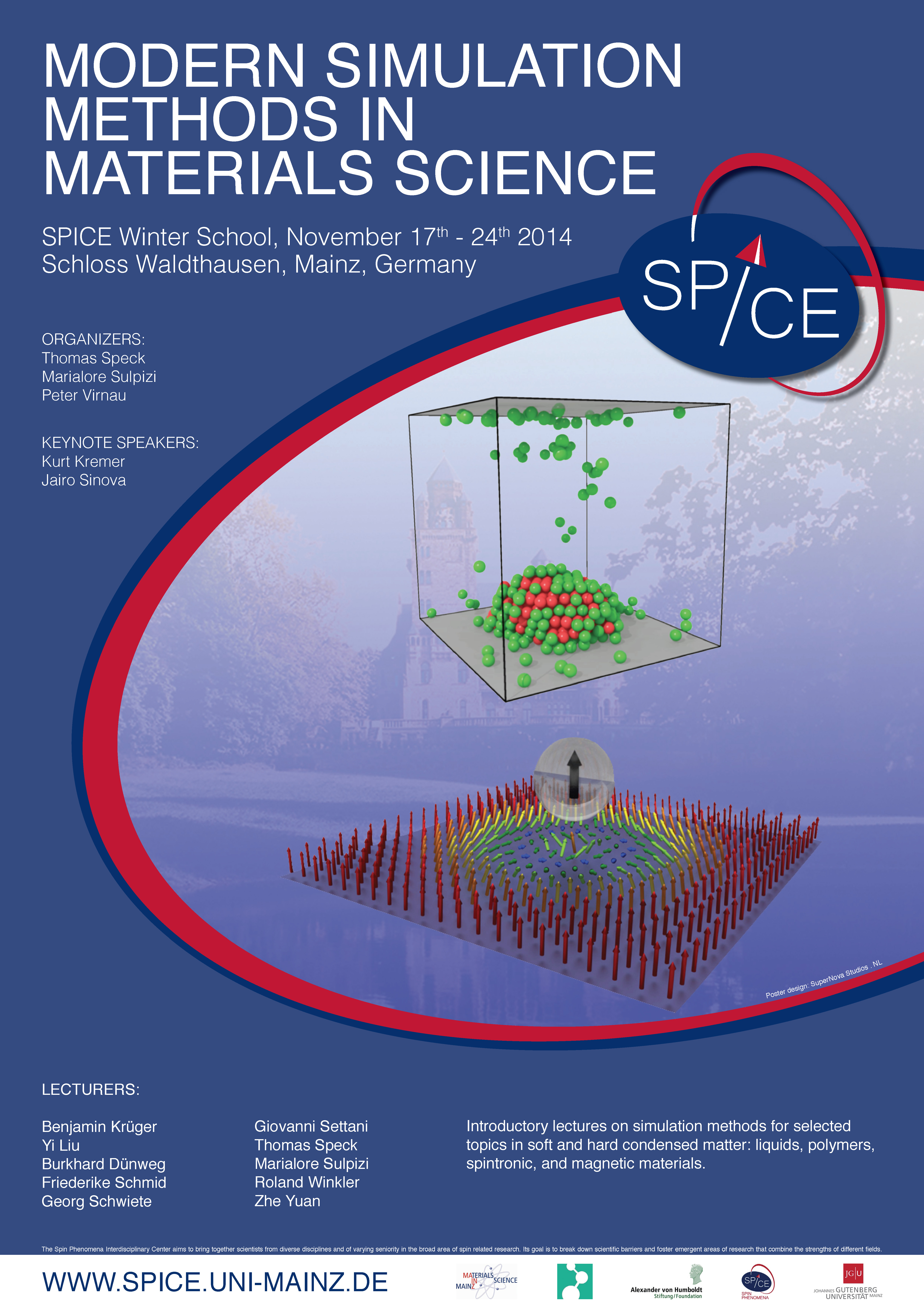 In collaboration with TRR 146, MAINZ and the Max Planck Institute for Polymere Research, SPICE hosts an introductory workshop on simulation methods for selected topics in soft and hard condensed matter: liquids, polymers, spintronic, and magnetic materials.
Workshops
| Year | Date | Workshop Title |
|---|---|---|
| 2026 | 1 - 3 September | Elastically Driven Phases and Dynamics in Quantum Materials |
| 2026 | 8 - 10 September | Emergent Topology and Unconventional Order in Quantum Matter |
| Date | SPICE Workshops 2019 | |
|---|---|---|
 | 7 - 12 July, 2019 | Gordon Research Conference: Spin Transport and Dynamics in New Geometries, Materials and Nanostructures |
| 17 - 19 Sept. 2019 | Skyrmionics Workshop for Young Researchers |
| 30 Sept.- 3 Oct. 2019 | Young Research Leader Group Workshop: Topomagnetism Is Coming - Relativity and Correlations in Topological Magnets |
| 7 - 10 Oct. 2019 | Antiferromagnetic Spintronics: from topology to neuromorphic computing |
| 15 - 18 Oct. 2019 | Molecular Electro-Opto-Spintronics |
| 12 - 15 Nov. 2019 | Novel Electronic and Magnetic Phases in Correlated Spin-Orbit Coupled Oxides |
| 9 - 11 Dec. 2019 | Elastic Tuning and Response of Electronic Order |
| Date | SPICE Workshops 2018 | |
|---|---|---|
| 23 - 26 Oct. 2018 | Ultrafast Spintronics: From Fundamentals to Technology |
| 8 - 12 Oct. 2018 | Spintronics meets Neuromorphics |
| 3 - 7 Sep. 2018 | Joint European Magnetic Symposia 2018 |
| 10 -13 July 2018 | Young Research Leaders Group Workshop: Collective phenomena in driven quantum systems |
| 15 - 18 May 2018 | Spin Cavitronics |
| 8 - 11 May 2018 | Quantum Thermodynamics and Transport |
| Date | SPICE Workshops 2017 | |
|---|---|---|
| 25 - 27 Oct. 2017 | Antiferromagnetic Spintronics |
| 25 - 28 Sep. 2017 | Exotic New States in Superconducting Devices:The Age of the Interface |
| 31 Jul. - 4 Aug. 2017 | Young Research Leaders Group Workshop:Insulator spintronics – strong-coupling, coherence and entanglement |
| 25 - 28 Jul. 2017 | Topology Matters |
| 11 Jul. 2017 | Network-Meeting SPP2137 Skyrmionics |
| 6 - 9 Jun. 2017 | Spin Dynamics in the Dirac Systems |
| 30 May - 2 Jun. 2017 | Non-equilibrium Quantum Matter |
| 17 - 19 May 2017 | Bridges to Germany: Junior Faculty ProfessionalDevelopment Workshop |
| 5 - 18 Feb. 2017 | Entanglement in Strongly Correlated Systems |
| Date | SPICE Workshops 2016 | |
|---|---|---|
| 08 - 14 Oct. 2016 | International School & Conference onNanoscience and Quantum Transport(Kiev, Ukraine) |
| 26 - 30 Sep. 2016 | Antiferromagnetic Spintronics |
| 21 - 23 Sep. 2016 | Quantum Spintronics: Spin TransportThrough Quantum Magnetic Materials |
| 8 - 19 Aug. 2016 | PhD SpinCaT Workshop – NewPerspectives for Spin-Caloritronics |
| 13 - 17 Jun. 2016 | Young Research Leaders Group Workshop:New Paradigms in Dirac-WeylNanoelectronics |
| 17 - 20 May 2016 | Quantum Acoustics – Surface AcousticWaves meets Solid State Qubits |
| Date | SPICE Workshops 2015 | |
|---|---|---|
| 23 - 24 Oct. 2015 | Spin Orbit Coupling and Spin Mechanics |
| 14 - 15 Sep. 2015 | Spin Transport and Spin Pumping in Organics |
| 17 - 20 Aug. 2015 | Magnetic Adatoms as Building Blocksfor Quantum Magnetism |
| 3 - 14 Aug. 2015 | Young Research Leaders Group Workshop:Frontiers with strongly correlated andtopological mesoscopic systems |
| 29 Jun. - 2 Jul. 2015 | Bad Metal Behavior in Mott Systems |
| 22 - 26 May 2015 | Computational Quantum Magnetism |
| Date | SPICE Workshops 2014 | |
|---|---|---|
| 17 - 20 Nov. 2014 | Modern Methods in Materials Science |
| 24 - 25 Mar. 2014 | Lanna Meeting - Mainz |
First steps at the institute
Register with the institute
Germans love forms. So the first thing to do when you are new at the institute is to fill in a personal form to register with the institute. Hand it in to Juliane, our group secretary (room 01-323 or 01-325). She will sign it and forward it to the institute administration. Note that without having registered with the institute, you will not get a key.
Once you leave the institute, you have to de-register by filling in another form at the group office.
How to get a key
- Fill in a key form (available at the group office), have it signed by Juliane, the group secretary
- hand it in at the budget management office (Etatverwaltung), room 01-621. In return for a € 50 deposit, you will receive the budget manager's signature, which entitles you to get the key.
- Contact Mr. Gries (room 01-132, mobile phone: 0175-7250983) to arrange for a time for him to hand you the key.
Please make sure you give back your key personally before you leave. Our colleagues from the budget management will not give back the deposit to anybody else unless you provide a formal written authorization.
Note that you are personally liable in case you lose the key.
How to get a university-email account
As a guest at the university, you can get a university email account. To get one, please contact Andreas Nussbaumer:
|
Staudingerweg 7 nussbaum@uni-mainz.de |
If you have an employment contract, your e-mail account will be created automatically.
How to get a card for the canteen
On the first floor of the canteen (Mensa), there's a little stand where you can buy a card for the canteen. You can also ask one of our student assistants to get one for you for 2,50 €.
Business trips
During your visit here, business trips have to be notified to the university administration regardless if you are employed at JGU or if you work here as a guest scientist. In order to do so, use the travel application form „Dienstreiseantrag.“
Fill in the form and sign it, then hand it in to the group office (room 01-323 or 01-325).
How to get back travel expenses
In order to get reimbursed for your travel expenses, fill in the request form (Antrag auf Reisekostenvergütung). Hand it in to the group secretariat along with all payment documents (receipts, tickets etc.) The financial department only accepts original payment documents, no photocopies. Unfortunately, the forms of the financial department are only available in German. You can get help with filling them in at the group office (room 01-323 or 01-325).
Search the SPICE website
How to reach Spin Phenomena Interdisciplinary Center (SPICE)
SPICE is located on the campus of the Johannes Gutenberg-University Mainz, accessible by a 30-minute train or car ride from Frankfurt International Airport (FRA).
Traveling to Mainz:
By plane: There are two airports at Frankfurt, where you possibly arrive.
Frankfurt Airport (FRA) is an international airport that is about 30 km to Mainz. From the airport you can take the frequent local train service (S-Bahn) S8 (at Platform 3) with final destination Wiesbaden (takes approx. 30 minutes) or the Intercity/Eurocity train (20 minutes). Please get off the train at Mainz Hauptbahnhof (Hbf).
Frankfurt-Hahn airport (HHN) in the Hunsrück region is around 90 kilometers away, where you can find Ryanair, SunExpress, and Wizz air flights. There is a bus shuttle (70 minutes) to Mainz.
By train: Please get off the train at Mainz Hauptbahnhof (Hbf). Timetables are available at the travel information service run by the RMV regional transport authority and Deutsche Bahn.
Transport in Mainz:
We recommend downloading DB Navigator from the Apple App Store/Google Play Store to your phone.
Enter the address of your hotel or the venue to find which train/bus to take. More information on the app can be found here.
You can also purchase tickets via the app.
By bus: After arriving at Mainz Hbf, please exit the station from the back entrance and head towards the bus stop "Hauptbahnhof West". From there you can take the tram lines no. 51 / 53 / 59, or the bus lines no. 54 / 55 / 56 / 650 / 75. For further information visit the website of the MVG.
If you arrive by S-Bahn holding an RMV ticket it is also valid for the local bus within Mainz. Otherwise you have to buy a ticket for the city.
Do not exit at the stop "Universität" but continue until the next stop, "Friedrich-von-Pfeiffer-Weg". The University is on the left-hand side from the direction of traffic. Pass the street and continue to the right, past the high-rise building on the left after about 150 m and then turn left onto "Staudingerweg". After approx. 50 m you will pass the university canteen (Mensa) on your right-hand side. The Institute of Physics (Staudingerweg 7) is right after it.
SPICE Advisory Board
The SPICE Advisory Board aids in evaluating the applications to organize workshops and schools at SPICE and in matters relating to its strategic direction:
- Carlo Beenakker, University of Leiden; Homepage
- Gerrit Bauer, Tohoku University; Homepage
- Burkard Hillebrands, RPTU in Kaiserslautern, Germany; Homepage
- Tomas Jungwirth, Academy of Sciences of the Czech Republic, The Czech Republic; Homepage
- Mathias Kläui, Johannes Gutenberg Universität Mainz, Germany; Homepage
- Stuart Parkin, IBM Almaden Research Center and Max-Plank Halle, USA and Germany, Homepage
Information for potential organizers of a SPICE workshop
We encourage applications for a SPICE workshop if you want to organize an interdisciplinary workshop on an emergent field or where two distinct fields or sub-areas are brought together to cross new frontiers and seek to overcome challenges that each on its own may not be able to do.
We also would like to emphasise that in spite of the spin connection to the center, we consider all areas of condensed matter physics for potential workshop topics as well.
The proposals should arrive at least 8-9 months before the intended date for full consideration. Although there is no formal limit on the length of the proposal; we recommend to keep things within three to four pages.
Currently we have three possible formats:
-
SPICE workshops or schools: these workshops should merge different fields or areas that typically have not interacted strongly before or be on a very active emergent topic.
-
SPICE-MITP workshops: these workshops are of similar scope as the regular workshops but with a reduced number of senior participants that will interact for one to two weeks in the Mainz Institute of Theoretical Physics.
-
SPICE Young research leaders group workshops: here the leading coordinators are top level young researchers, coming together to explore new research areas or specific challenges defined by the new generation.
The proposals will be evaluated as rapidly as possible with the help of the directing team and the SPICE Advisory Board. Please find below specific instructions for the workshop proposal, the expected format, etc., and what is provided by SPICE.
Writing a proposal
The proposals should contain information about (1) title, (2) organizers, (3) general motivation, (4) aspects of interdisciplinarity, (5) participants and key speakers, (6) preferred dates for the workshop, and (7) poster motif. In section (8) below we give also co-sponsors and budget considerations together with information of what SPICE provides.
These topics are further expanded upon below. For any further questions related to proposal preparation or the activities of SPICE please contact the members of the SPICE team or the center directly at: spice@uni-mainz.de
Detailed description of the proposal
Please submit your proposal in pdf-format. Although there is no formal limit on the length of the proposal, we recommend to keep the entire length within four pages.
Title
Keep in mind that it should attract people from other disciplines. Clear, interesting, and attention grabbing is always a plus. The interdisciplinary character of the workshop should reflect itself in the title.
Organizers
-
Provide full contact details of all organizers. Indicate who will be the organizer that will be primarily in contact with the SPICE staff.
-
Describe why each organizer: expertise, motivation, what he/she brings to the organization of the workshop and which community will he/she attract to participate.
-
SPICE encourages the organizers to write a short "perspective" article after the completion of the workshop that can serve as a roadmap for the possible emerging field. Invitations for participation of editors from major journals are encouraged.
-
One of the organizers should be from a German institution but we encourage the organizing team to be broadly international. If the topic is closed to the research field at JGU a SPICE scientific member can be one of the organizers.
General motivation
-
A short scientific case of why a workshop on the proposed topic is timely and what you want to achieve. This should be aimed to non-experts. Describe the topics of the workshop. Be specific about scientific challenges and targets. This input is typically used in creating the webpage for the workshop.
-
It is important to articulate here how you would envision the impact of a successful workshop. Who would need to come and interact? How would the interdisciplinary character help or be measured?
Aspects of interdisciplinarity
-
Please specify topics which connect the participants from the different fields (common techniques, phenomena, problems, goals...). How synergistic is the workshop and does it have a possibility to generate new fields? Why is the topic of particular current interest and emergent?
-
Provide a specific plan on how interdisciplinary learning and research could be achieved between the participating disciplines or subfields. Also note that to promote interdisciplinary learning and collaboration, we require imbedding talks and overview tutorials aimed at the complementary disciplines. These tutorials should be given by top communicators, not merely the senior leaders in their fields (sometimes the two are not the same). Ideally, half of people should not know they other half. If an imbalance exists, the minority should be given a preferential schedule (afternoon of the first day, etc.) in order to foster communication during the workshop.
-
Another key aspect is inter-generational. At least 1/4 of the invited speakers should represent the next generation of the fields.
Participants, Key speakers
-
Give an estimate of the expected number of participants and a list of the invited speakers.
- We aim also for a gender balance and at about 1/3 or more of the speakers to be female researchers.
-
Participation of the vast majority of the participants during the entire workshop period is important.
-
Indicate the expected ratio of senior to junior participants. Note that 1/4 is a minimum ratio required; higher numbers are encouraged.
-
Provide information about the key speakers (in particular for the tutorials). Are they the best communicators? What is their status of commitment? Indicate whether they have confirmed their participation.
-
All talks are taped and posted on our YouTube channel. Talks discussing unpublished work can be put on hold until the work has been submitted for publication. Participants should be made aware of this.
Preferred dates for the workshop
-
Please state preferred dates for the workshop. If possible, indicate several alternatives.
-
Try to avoid clashes with other important conferences in the respective fields.
-
The typical length of a workshop is 3-4 days for a workshop held at Wasem or similar location. For the ones held at MITP it can be between 1 week depending on the availability. If you choose a different length, please indicate your motivation.
Poster Motif
Provide a graphics that could serve as a poster motif later on. Note that SPICE collaborates with a professional designer for the final poster design.
Co-sponsors, budget considerations, and what SPICE provides
SPICE provides
-
Staff support
-
Workshop poster
-
The center will coordinate proposal writing to obtain funding to be able to provide the workshop fees and lodging costs for the invited speakers (typically up to 25 people and up to 4 days). The German organizers will be the one submitting funding requests to the DFG if necessary.
In the proposal you should identify possible co-sponsors, their level of commitment or possibilities. A typical workshop of about 40 people will require some participation fees that may vary depending on the length of the workshop, support from co-sponsors, the degree of support for the lodging, etc. For non-invited speakers is it typical to require a non-refundable fee. Instead of requesting you to calculate a budget at this stage, we ask you to contact us directly for discussing the possible parameters so we can advise on what has worked well in the past.
Proposal Example
» Quantum Acustics Workshop (pdf)
» Quantum Acustics Workshop (docx)